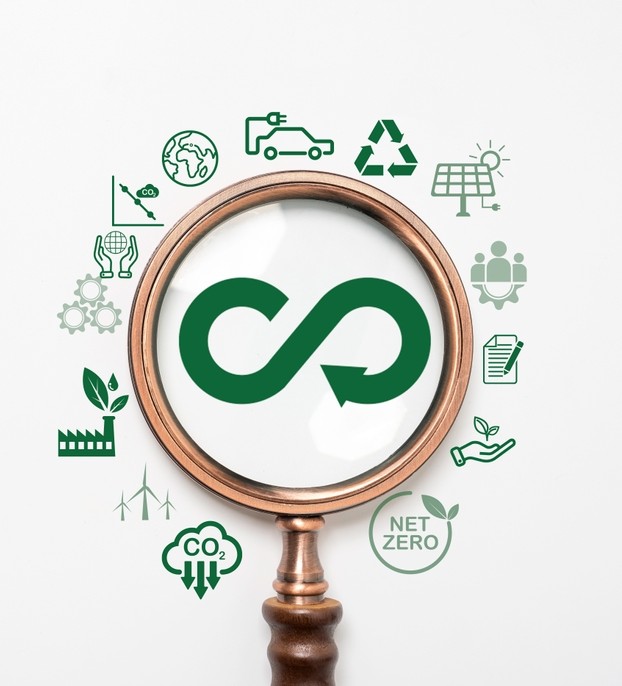
Transportation Decarbonization Infrastructure
The Native Operational Architecture
Telematics platforms, GLEC, ISO 14083, IFRS, ISSB, MRV frameworks and carbon registries already operate independently across transportation ecosystem. However, each was designed to serve a specific function, not to operationalize an end-to-end transportation decarbonization lifecycle.
The Transportation Decarbonization Infrastructure is transportation’s first and only native emission reduction infrastructure, operationalizing real-world environmental performance into climate governance, economic participation, and institutional trust. It transforms transportation activity into authenticated emissions intelligence that can be governed, valued, and administered at scale. By integrating these existing platforms, frameworks, standards and registries through a shared foundation of environmental evidence, the Transportation Decarbonization Infrastructure enables governments, enterprises, financial institutions, climate markets, and individuals to participate within a unified accountability ecosystem where verified climate actions generate tradable climate assets.
The Missing Foundation of Transportation Emission Reductions & Climate Finance
Transportation has evolved into one of the world’s most regulated and economically significant sectors, although its environmental administration has remained institutionally incomplete. Transportation emissions are measured, reported and regulated, but rarely governed through a continuous accountability architecture. It attracts significant investment, but operational emissions reductions have largely remained outside financeable climate-asset frameworks. The Transportation Decarbonization Infrastructure establishes transportation’s first persistent Climate AI Twin Engine, where every verified climate action compounds into institutional evidence, economic participation and long-term climate value.


One Architecture. Every Transportation Climate Outcome.
→ Auditable Transportation Emissions Accountability enabling autonomous verification, regulatory oversight, and evidence-based climate action.
→ Article 6.4 Transportation Climate Asset Generation connecting verified transportation outcomes with carbon markets, environmental incentives, and climate finance mechanisms.
→ Sovereign Transportation Climate Reporting establishes Nationally Determined Contributions (NDCs), transportation decarbonization programs, and national climate responsibility.
→ Operationalizing the UN Decade of Sustainable Transport enabling transportation participation within internationally recognized climate frameworks and emerging environmental markets.
→ Transportation Climate Finance Infrastructure generating carbon credits, delivering incentive programs, formulating green finance instruments, and performance-based environmental sustainability mechanisms.
→ Lifecycle Accountability Systems recognizing maintenance, refurbishment, asset life extension, resource efficiency, and circular economy contributions as measurable transportation outcomes.
→ Policy-Aware Governance Architecture capable of operating across jurisdictions, technologies, regulatory environments, and evolving transportation ecosystems.
Climate Value Begins With Trust.
Climate economies cannot function without trust. Every climate asset, carbon credit, incentive, treasury transaction, and institutional decision depends upon environmental evidence that is autonomously verified, continuously reconciled, and persistently maintained. Through the Transportation Decarbonization Infrastructure, trust is not declared—it is engineered through cryptographically protected evidence chains, immutable accountability records, lifecycle traceability, and verifiable environmental intelligence, enabling the tokenization of climate assets with institutional confidence and economic integrity.

Powered by
The Mobility Carbon AI Twin Engine
Data
Reality
Captures mobility activity from inspections, telemetry, maintenance systems, infrastructure networks, mobility platforms, and operational sources.
Context
Authentication
Interprets transportation activity through operational Intelligence and neural networks, generating contextual insights, behavioral patterns, and climate outcome.
Carbon
Accounting
Converts data intelligence into emissions records, lifecycle accountability metrics, environmental calculations, and climate performance datasets.
Policy
Governance
Applies jurisdictional policies, regulatory requirements, compliance controls, program rules, climate administration, finance and compliance frameworks.
Treasury
Intelligence
Establishes auditable chains of custody enabling validation, reconciliation, traceability, transparency, environmental integrity, and accountability assurance.
Capital
Tokenization
Creates blockchain enabled digital ledgers operating as central authority for traceability, interoperability, lifecycle administration, transaction integrity, trade and policy execution.
Sustaining Climate Value Through Lifecycle & Circular Economy
Environmental performance was never intended to end with emissions reduction. It reaches its full potential when climate action continues through maintenance, governance, incentives, treasury, and economic participation. The Transportation Decarbonization Infrastructure extends every verified climate outcome into an active lifecycle, enabling a circular economy where climate value continues to circulate, mature, and compound.